Unblocking
A local blockage, water no longer flows: we open a passage.

Home › Drain unblocking › Drain jetting
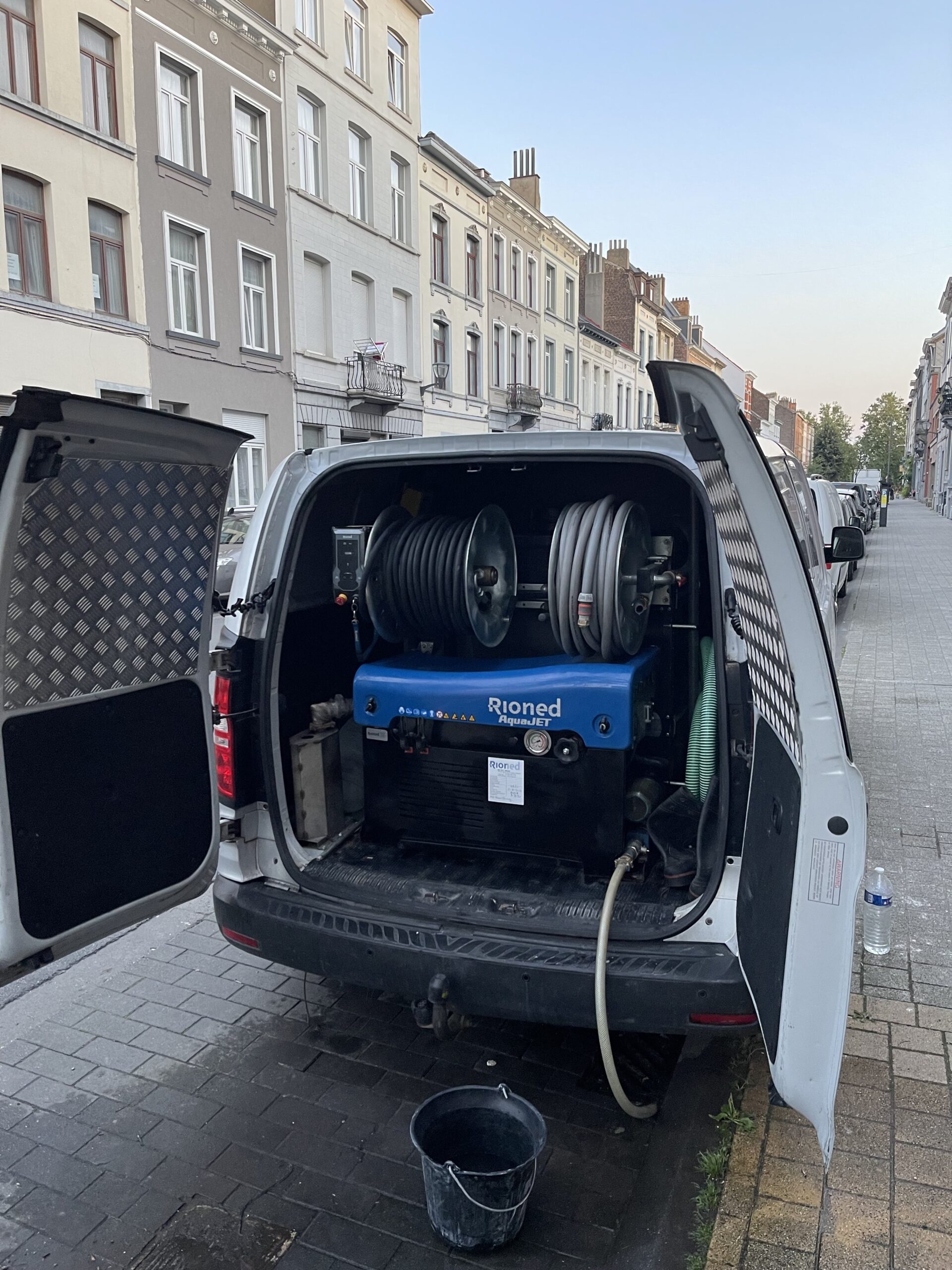
In short: Drain jetting cleans a pipe from end to end with high-pressure water. Service Technic Belgium does it across Wallonia, Brussels and Flanders, for houses, apartment buildings, businesses and farms. Call 0477 03 88 98.
Jetting gives a pipe back its full bore, rather than just punching a hole through a blockage. It is the right choice when deposits line the whole length, or when you want to stop a blockage forming at all.
★★★★★5,0on Google· 22 years of experience
Every kind of building has its own deposits. In a kitchen it is grease setting on the pipe walls; in a bathroom, soap and hair; in a utility room, fibres and detergent; in a yard or garage, sand and leaves coming in through the gullies.
Over time these deposits harden and mix with limescale. The passage can halve without anyone noticing, until the first big storm or the next family gathering.
Clay and concrete pipes in older houses also have joints that roots get into, and rough walls that everything catches on.
The technician picks an access point: an inspection chamber, a rodding eye, a yard gully. He feeds in the hose with a nozzle that suits the diameter and turns on the water.
Jets pointing backwards pull the nozzle forward. He runs it to the end of the section, then draws it back slowly while the water pushes the deposits towards the sewer, repeating until the water runs clear.
He then runs water from the highest fitting to check the flow, and records the sections cleaned on the job sheet.
A rear-jet nozzle handles routine cleaning. A slower rotating nozzle removes hard deposits and scale. A chain or cutter head removes roots that have come through the joints.
Pressure is matched to the material: PVC and concrete can take a lot, old cast iron and cracked clay need a gentle touch.
If he is unsure about an old pipe, the technician sends the camera in first rather than risk damaging it.
In towns we mostly jet building stacks, sewer connections and restaurant drains. In the countryside it is more often the pipe to a septic tank or treatment unit, and rainwater drains.
On farms and in workshops, yard gullies collect soil, straw or wood shavings. Jetting before winter stops the yard turning into a pond.
For businesses the frequency depends on the activity: a chip shop is not jetted at the same rhythm as an office.
After two blockages in a year in the same pipe, a full jetting costs less than clearing it again and again.
Before selling or buying a property, or before laying a terrace over the drains, jetting followed by a camera survey gives a true picture of their condition.
In an apartment block, jetting the kitchen stacks once a year, agreed at the general meeting, protects the ground-floor flats.
A local blockage, water no longer flows: we open a passage.
Deposits everywhere: we clean the whole pipe.
Regular jetting avoids emergencies.
After jetting, the picture is clear.
Jetting uses water alone.
The unit stays in the van; only the hose comes into the building.
Occupants avoid running water for a few hours.
An accessible chamber saves time on site.
Use whichever suits you and tell us your municipality.
You know the visit time and the call-out cost in advance.
Work starts once you agree. Keep the job sheet and the invoice for your records.
Trustindex vérifie que la source originale de l'avis est Google. Super quick intervention on a late Tuesday evening!Publié surTrustindex vérifie que la source originale de l'avis est Google. Top service. Very professional. Clear communication and no sneaky sales pitches. Problem identified, problem solved. Correct!Publié surTrustindex vérifie que la source originale de l'avis est Google. Très content du service : communication via emails, entretien de la chaudière avec photos avant/après. Je recommande !Publié surTrustindex vérifie que la source originale de l'avis est Google. Very professional and fast service!! TopPublié surTrustindex vérifie que la source originale de l'avis est Google. Very nice of plumbing thanks a lot!
Our technicians jet drains in all ten provinces and in Brussels. Tell us your municipality on the phone and we send the nearest one.
Not when the pressure and nozzle suit the material. On old pipes the technician starts gently and stops if they show weakness.
For a house, often one to two hours. For a building or a long collector, half a day or more; the office tells you when booking.
Yes. We jet the pipe and, if the tank is full, have it emptied at the same time so the deposits do not end up in it.
Yes, in Wallonia, Brussels and Flanders. You are told the call-out cost before we come.
Yes, for yards, car parks and garage ramps, including emptying silt traps where there are any.
Not for a house with no problems. For a restaurant, a building with a kitchen stack or a pipe invaded by roots, a regular schedule is worthwhile.
Call 0477 03 88 98, send us a WhatsApp message or book online with the « Book an appointment » button. Tell us the municipality and what is blocked.
Call 0477 03 88 98: house, building, business or farm, we agree a date with you.