Ignition and flame (F.28, F.29, F.68)
The burner does not light or loses its flame. No heating and no hot water until the cause is fixed.

Home › Heating › Error codes › VaillantService 7 days a week
Is your Vaillant ecoTEC boiler showing F.28, F.22 or F.75? The table lists the Vaillant fault codes from F.00 to F.93 with their meaning. The code shows which part of the boiler raised the alarm; finding why is the job of the technician. Our heating engineers repair Vaillant boilers 7 days a week, with the price announced before the repair.
★★★★★5,0on Google22 years of experiencePrice agreed before the work
Is your Vaillant boiler showing a code and won't restart? Call 0477 03 88 98: a heating engineer comes with the right parts and gives you the price before repairing. See also Vaillant heating engineer and boiler breakdown.
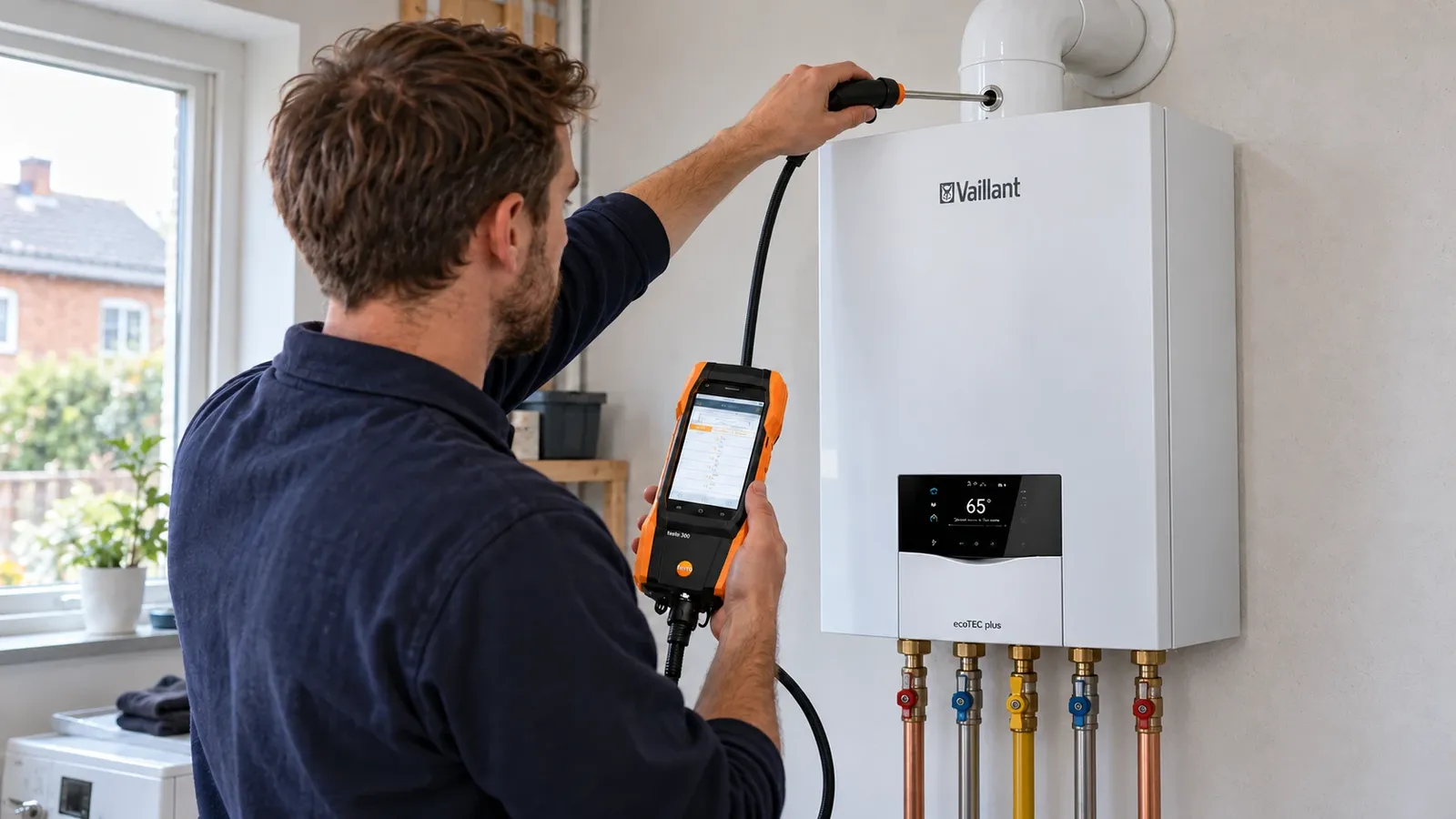
The ecoTEC range (ecoTEC plus, ecoTEC pure, ecoTEC exclusive) is one of the most widespread condensing boilers in Belgium, alongside older atmoTEC and turboTEC models. They all use the same F-code logic.
Ignition faults F.28 and F.29, low water F.22, pump pressure F.75 and the unstable flame F.68 are the codes we see week after week. Sensor codes (F.00 to F.13) are usually quick to solve once the faulty sensor or cable is found.
Our engineer measures before replacing anything, explains the cause in plain words and gives you the price first. Ignition electrodes, NTC sensors and pressure sensors for ecoTEC boilers are part of his stock.
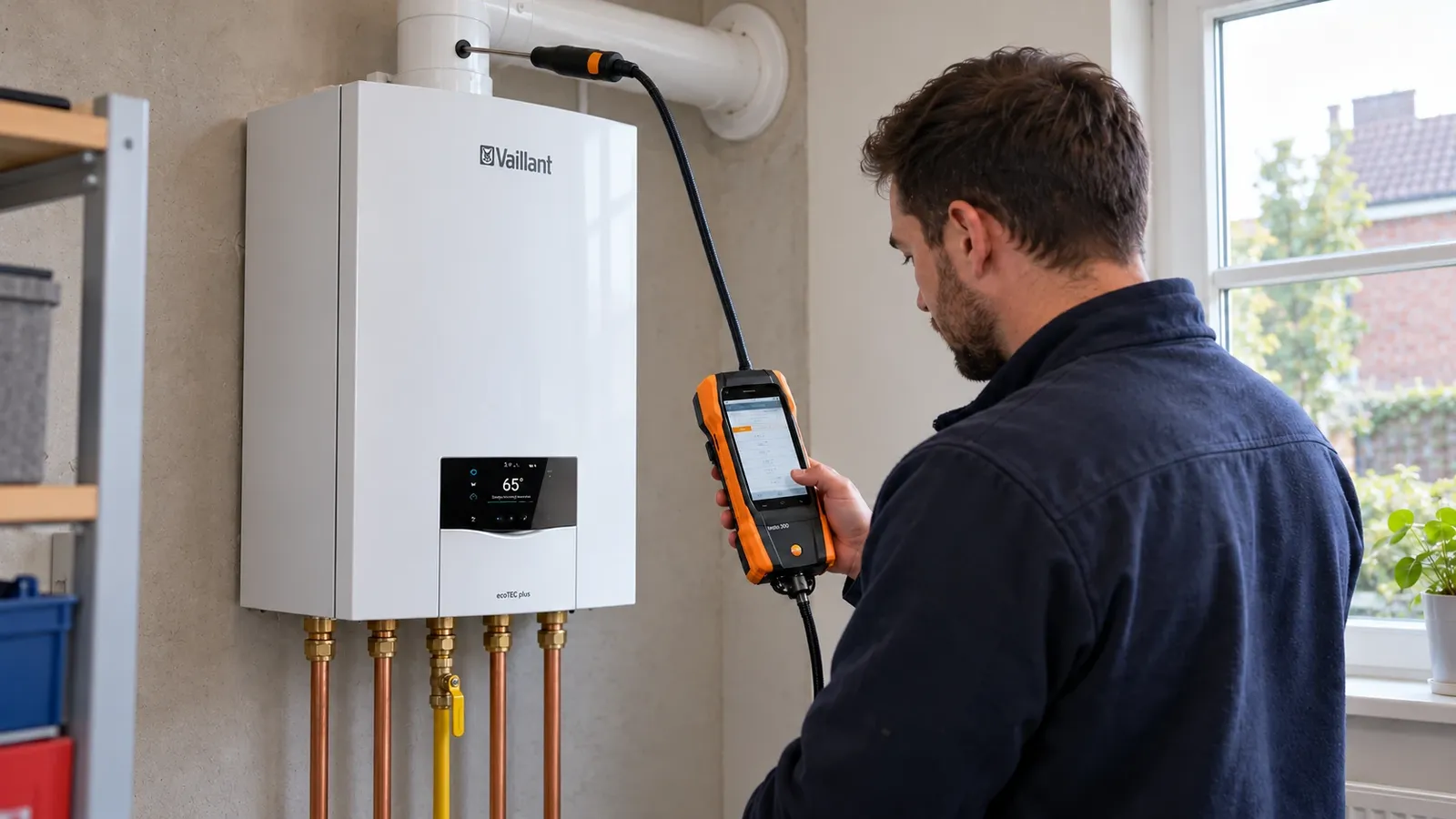
Many F.28, F.29 and F.93 codes are linked to combustion: a dirty burner, a blocked siphon, a venturi out of adjustment. The yearly service puts these right.
The technician cleans, analyses the flue gases with his combustion analyser, tests the safety devices and hands you the service attestation. He also checks the fault memory for codes you may not have noticed.
On a Vaillant ecoTEC boiler the display shows two kinds of code. S codes, such as S.04 or S.14, are status messages: they tell you what the boiler is doing, for example heating or waiting, and they are not faults. F codes are faults. When an F code appears, the boiler has stopped or locked out to protect itself.
F codes come in families. F.00 to F.13 usually point to a temperature sensor on the flow, the return or the hot water side, either disconnected or short-circuited. F.20 to F.29 are about overheating, low water and the flame: F.22 means too little water, F.28 a failed ignition at start-up, F.29 a flame lost during operation. Codes from F.61 onwards concern the gas valve, the electronics and the water pressure sensor, such as F.62 or F.75.
Write down the exact code, the boiler model on the front label (ecoTEC plus, ecoTEC pure, VC or VCW) and when it appears. Then call us on 0477 03 88 98. Our technicians speak English, French and Dutch.
First look at the pressure gauge. On most ecoTEC boilers it should read between 1 and 2 bar when cold. If it is below 1 bar, top it up with the filling loop under the boiler and press reset once. If the pressure keeps falling within days, there is a leak or an expansion vessel problem that needs a technician.
Second, for F.28 or F.29, check that the gas is on: is the gas hob working, is the meter valve open, has a prepayment meter run out? A frozen condensate pipe outside can also stop the boiler in winter. Third, do not reset more than two or three times. Repeated lockouts mean the cause is still there, and forcing the boiler can damage the ignition or the fan.
If the code comes back, a technician measures the gas pressure, the ignition electrode, the sensors and the combustion. More about a boiler that keeps locking out: boiler lockout. For servicing and repairs on Vaillant boilers: heating engineer for Vaillant.
Use the search box: type F.28, F.75 or any other code to jump to its line. The last column lists the parts and points the engineer inspects.
| Code | Meaning | What the technician checks |
|---|---|---|
| F.00 | Flow temperature sensor interruption | NTC connector loose/disconnected, broken cable, defective NTC sensor. |
| F.01 | Return temperature sensor interruption | NTC connector loose/disconnected, broken cable, defective NTC sensor. |
| F.02 | actoSTOR charging sensor interruption (NTC) | Defective NTC sensor/cable, connection issue with NTC/actoSTOR. |
| F.03 | actoSTOR cylinder sensor interruption (NTC) | Defective NTC sensor/cable, connection issue with NTC/actoSTOR. |
| F.10 | Flow temperature sensor short circuit | Defective NTC sensor, short circuit in cables/housing. |
| F.11 | Return temperature sensor short circuit | Defective NTC sensor, short circuit in cables/housing. |
| F.12 | Cylinder charging sensor short circuit (NTC) | Defective NTC sensor, short circuit in cables/housing. |
| F.13 | Pre-heating/cylinder sensor short circuit (depending on model) | Defective NTC sensor, short circuit in cables/housing. |
| F.20 | Safety cutout: temperature limiter | Incorrect grounding, defective flow/return NTC, discharge via cable/ignition electrode. |
| F.22 | Safety cutout: low water level | Insufficient water, water pressure sensor/pump: cable loose/disconnected/defective; defective pressure sensor. |
| F.23 | Safety cutout: ΔT too high | Pump blocked/low power, air in appliance, flow and return sensors swapped. |
| F.24 | Safety cutout: temperature rise too fast | Pump blocked/low power, air, insufficient system pressure, gravity brake blocked/incorrectly installed. |
| F.25 | Flue gas temperature too high | Flue gas safety switch (STB) interrupted, broken cable. |
| F.26 | Gas valve assembly not functioning | Stepper motor disconnected/poorly connected, broken cable, motor or PCB defective. |
| F.27 | Flame simulation | Moisture, defective flame detector, gas valve leaking. |
| F.28 | Ignition fault: failure to ignite | Insufficient gas/pressure, air in gas, DCT activated, clogged condensate drain, defective injector/gas valve, wiring/ionization/grounding issues, PCB failure. |
| F.29 | Fault in operation: failure to reignite | Gas supply interrupted, flue gas recirculation, clogged condensate drain, grounding fault, ignition failure. |
| F.32 | Fan fault | Connectors poorly attached, broken cable, fan blocked, Hall sensor/PCB defective. |
| F.42 | Coding resistor error | Short circuit/interruption of power coding resistor (cable) or gas type coding (PCB). |
| F.49 | eBUS fault | eBUS short circuit/overload, reverse power supply on eBUS. |
| F.52 | Flow rate sensor/venturi contact fault | Connector poorly attached/disconnected/defective, poor contact, defective sensor. |
| F.53 | Combustion control fault | Insufficient gas pressure, incorrect gas setting (LPG vs G20), venturi or gas valve assembly defective/blocked/wet. |
| F.54 | Gas supply fault | Gas valve(s) closed, insufficient dynamic pressure, defective gas valve. |
| F.56 | Combustion component fault | Poor contact at gas valve, incorrect gas adjustment, defective gas valve. |
| F.57 | Comfort mini mode cancelled | Control issue detected; ignition electrode severely corroded. |
| F.61 | Gas valve control fault | Gas supply wiring defective, gas valve or PCB defective. |
| F.62 | Delayed gas valve shutoff | Stray flame, gas valve or PCB defective. |
| F.63 | EEPROM error | Electronic system defective. |
| F.64 | Electronics/NTC sensor error | Short circuit in flow/return sensor or defective electronics. |
| F.65 | Electronics overheating | Overheating due to environmental factors, defective electronics. |
| F.67 | Electronics/flame error | Unrealistic flame signal, defective electronics. |
| F.68 | Unstable flame signal | Air in gas, low pressure, incorrect air ratio, clogged condensate drain, wrong injector, ionization interruption, flue gas recirculation. |
| F.70 | Invalid device identification (DSN) | PCB/display replaced without setting DSN, coding resistor missing/incorrect. |
| F.71 | Flow temperature sensor error | Constant value: sensor incorrectly placed or defective. |
| F.72 | Flow and/or return sensor error | Illogical ΔT → defective sensor(s). |
| F.73 | Water pressure sensor signal – too low | Interruption/short circuit of sensor, defective wiring. |
| F.74 | Water pressure sensor signal – too high | Short circuit to 5V/24V, internal pressure sensor fault. |
| F.75 | No pressure change when pump starts | Pressure sensor, pump, air in the circuit, water content, bypass, expansion vessel. |
| F.77 | Flue damper / condensate pump fault | No feedback from damper or defective condensate pump. |
| F.78 | DHW output sensor interruption/short circuit | Connection module present but sensor not jumpered. |
| F.80 | Secondary exchanger sensor interruption/short circuit | Defective NTC sensor/cable, poor contact, short circuit, defective sensor. |
| F.81 | actoSTOR charging pump defective | Cylinder charging, sensors, air in the pump, cables, turbine, valve, heat exchanger, charging pump. |
| F.83 | Flow/return temperature variation error | No/insufficient temperature rise at burner start: insufficient water, sensor misplaced. |
| F.84 | Illogical temperature difference | Flow and return sensors swapped/installed incorrectly. |
| F.85 | Sensor incorrectly mounted | Sensor(s) installed on wrong pipe. |
| F.90 | actoSTOR communication interrupted | Cable between the boiler and the actoSTOR module, setting D.092 when no module is fitted. |
| F.91 | actoSTOR sensor/actuator error | Sensors and actuators of the actoSTOR module (see F.80 to F.83). |
| F.92 | Coding resistor error (gas type) | Coding resistor compared with the gas type, boiler configuration. |
| F.93 | Poor combustion quality | Wrong injector, recirculation, defective/dirty venturi system. |
Code not in this table: call us, our technician knows it.
Smell of gas? Do not touch any switch, open the windows, leave the house and call 112 from outside. For any other code, write it down and call us: the technician knows what to look at and brings the right parts.
The burner does not light or loses its flame. No heating and no hot water until the cause is fixed.
The boiler protects itself because the circuit lacks water or the pressure reading is wrong. A pressure that keeps dropping points to a leak.
A temperature sensor, the board or the display is faulty. The boiler may stop completely or run with reduced comfort.
Trustindex vérifie que la source originale de l'avis est Google. Super quick intervention on a late Tuesday evening!Publié surTrustindex vérifie que la source originale de l'avis est Google. Top service. Very professional. Clear communication and no sneaky sales pitches. Problem identified, problem solved. Correct!Publié surTrustindex vérifie que la source originale de l'avis est Google. Très content du service : communication via emails, entretien de la chaudière avec photos avant/après. Je recommande !Publié surTrustindex vérifie que la source originale de l'avis est Google. Very professional and fast service!! TopPublié surTrustindex vérifie que la source originale de l'avis est Google. Very nice of plumbing thanks a lot!
Vaillant boilers are repaired and serviced by our team everywhere in Belgium: Brussels, Wallonia, Flanders. Call us to learn the first time an engineer can reach you.
Our technicians work on all brands: they install, service and repair appliances from the major manufacturers. For a new installation, we recommend the model that suits your home and budget.











We buy our equipment from all the major Belgian wholesalers and suppliers, including Facq, Van Marcke and Desco: genuine parts, quickly available.



Ignition failure at start-up: the boiler tried to light the burner without success. Gas supply, gas pressure, electrodes, condensate drain or gas valve are inspected.
F.28 happens when the burner fails to light; F.29 when the flame goes out during operation and the boiler cannot relight it.
There is too little water in the heating circuit, or the pressure sensor or pump reports an error. If the pressure keeps falling, there is probably a leak to find.
When the pump starts, the boiler expects a small pressure change and does not see it. The pump, the pressure sensor, air in the circuit or the expansion vessel can be the cause.
No. A boiler that keeps locking out has a real fault. Note the code and call us: the engineer comes with the parts most likely to be needed.
No. S codes, such as S.04 or S.31, are status messages that show what the boiler is doing at that moment. Only F codes are faults. If your boiler shows an S code but the radiators stay cold, note the code and call us.
F.62 points to the gas valve closing too slowly after the burner is switched off. It is a safety fault: do not keep resetting the boiler. A technician checks the gas valve, its wiring and the flame detection.
Yes, both recent ecoTEC models and older atmoTEC or turboTEC boilers. If a repair is no longer worth it, we give you a free quote for a replacement.
Call us or book online: an engineer comes over with the usual Vaillant spare parts. Call 0477 03 88 98 or see our Vaillant heating engineer page.